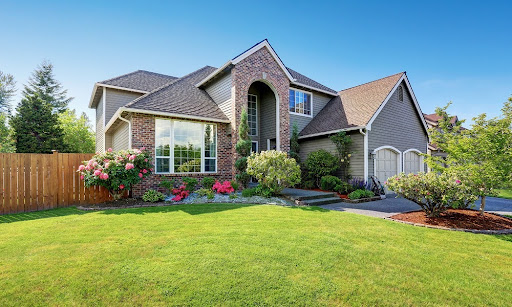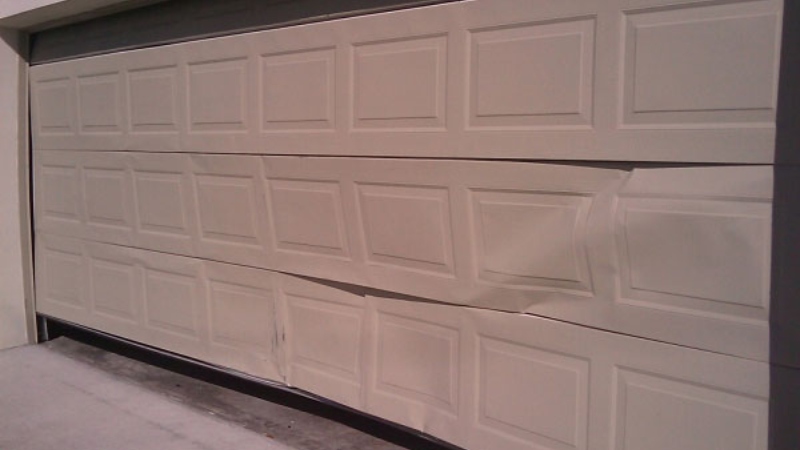
It happens to almost everyone eventually. A teenager learning to drive misjudges the turn, a basketball game gets a little too competitive, or a hailstorm rolls through. Suddenly there’s a dent, crease or crack in the garage door.
Sometimes it’s just cosmetic. Other times, a damaged panel affects how the whole door moves, how well it seals, and how safe it is to operate. Knowing the difference can save you money, and help you avoid a bigger repair down the road.
Here’s how to size up panel damage and decide whether to live with it, fix it, replace a section or replace the whole door.
How Panels Get Damaged
The most common causes are a car bumper, a door that closed on something, flying balls and yard equipment, storms and hail, and simple age. How a door responds depends a lot on what it’s made of:
| Material | Typical damage | Notes |
| Single-layer steel | Dents and creases easily | Thin skins show every bump; rust can start where paint cracks |
| Insulated steel | More dent-resistant | The foam core supports the skin, but impacts can still crease it or separate the layers |
| Wood | Cracks, splits, rot and warping | Moisture is the biggest enemy; damage can spread if the finish fails |
| Composite / faux wood | Resists dents and rot | Hard impacts can crack the surface |
| Aluminum and glass | Dents in frames, cracked or broken glass | Glass panels can often be replaced individually |
| Fiberglass | Cracks and fading | Can become brittle in cold weather or with age |
In wet climates, any damage that breaks the finish, such as a crease in steel or a crack in wood, deserves attention quickly, before moisture gets in.
Cosmetic or Structural?
Watch the door open and close a few times, then look closely at the damaged area.
Likely cosmetic:
- A shallow dent in the middle of a panel, away from the edges and hinges
- Paint scuffs or scratches with no rust or cracking
- A door that still opens and closes smoothly and evenly
Likely structural:
- A dent or crease near the edges of a section, where hinges or rollers attach
- A panel that’s bowed, bent inward or pulling apart from the sections above or below it
- Cracks, holes or split seams
- Hinges, struts or roller brackets that are bent or pulled loose
- A door that now rubs, binds, hangs unevenly or won’t seal against the floor
- Gaps between sections that let in light, water or pests
If the door is moving differently since the damage happened, stop using the opener and have it checked. A bent section can stress the tracks, rollers and springs, and in some cases knock the door off track.
Your Options, From Simplest to Biggest
- Leave it, or touch it up. A small cosmetic dent may not be worth fixing at all. If the paint is chipped, clean the spot, prime it with a rust-inhibiting primer and touch it up to keep moisture out.
- Minor dent repair. Some shallow dents in steel can be gently worked out from behind, and fillers can smooth small imperfections before repainting. Results vary, and it’s easy to make a dent worse, so be cautious with DIY methods.
- Replace one section. Most residential garage doors are made of three to five horizontal sections. If the damage is limited to one or two, a technician can often replace just those sections, as long as matching panels are still available. This is usually far less expensive than a new door.
- Replace the whole door. A new door often makes more sense when:
- Several sections are damaged
- Matching panels have been discontinued
- The door is older, uninsulated or showing other wear
- The cost of new sections and labor approaches the price of a new door
If you’re replacing it, it’s a good time to consider an insulated, more dent-resistant door, and to have the springs resized for the new door’s weight.
Matching Panels, Insurance and What to Ask
Matching. Even when a replacement section is available, color can differ slightly after years of sun exposure. Ask whether the new section will need painting to match, and whether your door’s design, window style and texture are still made. A technician can usually identify the manufacturer and model from a label on the inside of the door.
Insurance. Damage from a vehicle, a storm or hail may be covered by homeowners or auto insurance, depending on your policy and deductible. Take photos before any repairs, and ask your repair company for a written estimate you can submit.
Questions to ask your technician:
- Is the damage only cosmetic, or has it affected the door’s structure, hardware or balance?
- Can the damaged section be replaced, and will it match?
- Did anything else get damaged, like the tracks, rollers, hinges or opener?
- How does the cost of section replacement compare with a new door?
- What warranty comes with the work?
Preventing Damage, and When to Call a Pro
A few habits help keep panels in good shape:
- Wait until the door is fully open before pulling in or backing out
- Add a parking aid, such as a ceiling-mounted ball or a wall bumper, so cars stop in the right spot
- Keep sports and play away from the door, or consider a sturdier insulated door if the driveway doubles as a court
- Keep the safety sensors clean and aligned so the door doesn’t close on objects
- Wash the door and touch up chips to protect the finish, especially in wet climates
Call a technician if the door operates differently after the damage, a section bows or cracks near the edges, hinges or rollers bend, or you cannot determine whether the damage affects the door’s structure. Replacing a section means taking the door apart while the springs are under tension, so it isn’t a DIY job.
A dent doesn’t always mean a big bill. With the right assessment, many damaged doors can be fixed one section at a time and look good as new.
About the Author
This article was written by the team at Ryder Garage Doors, a locally owned garage door company with offices in Vancouver and Kelso, Washington, serving homeowners and light commercial clients across southwest Washington and the Portland, Oregon area. The team installs and repairs garage doors, panels, springs and openers, and backs its work with a one-year parts and labor warranty.
Click here for more details.