When homeowners think about garage door safety, springs usually get the attention. But running alongside them are two thin steel cables that carry just as much load, and when they fail, the results can be just as serious.
Cables are easy to overlook. They sit at the edges of the door, they rarely make noise, and they often look fine until the day they don’t. A frayed or slipping cable can drop one side of the door, twist it out of its tracks, or let it come down fast.
Here’s what garage door cables do, how to spot trouble early, and what to do if one breaks.
What Cables Actually Do
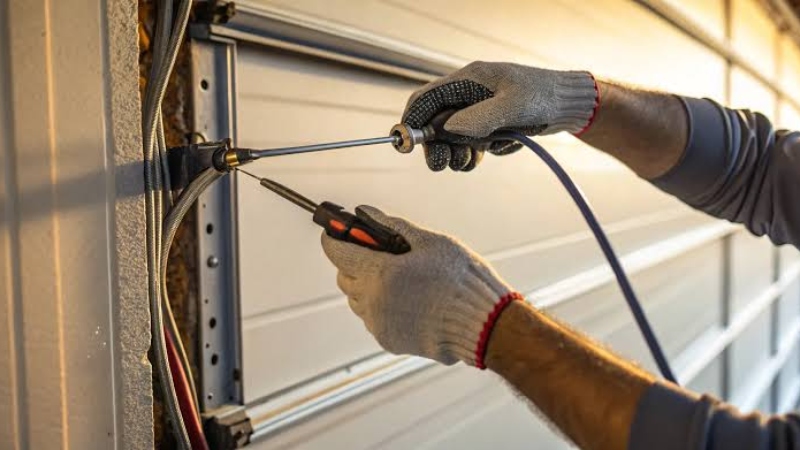
Springs store the energy that lifts your garage door. Cables deliver it. Each cable runs from a bracket at the bottom corner of the door up to the spring system, and as the springs release energy, the cables pull the door up evenly on both sides.
How they work depends on your spring system:
- Torsion systems. The springs sit on a bar above the door. A cable drum at each end of the bar winds the cables up as the door opens and lets them out as it closes. The cables must wind evenly in the grooves of the drums so both sides of the door lift together.
- Extension systems. The springs run along the horizontal tracks. Lift cables run through pulleys and stretch the springs as the door closes. These systems should also have separate safety cables running through the center of each spring, so a broken spring can’t whip loose.
In both cases, the cables carry most of the door’s weight at all times, whether the door is moving or standing still.
Warning Signs of Worn Cables
Cables usually give some warning before they fail. Look, from a safe distance and without touching, for:
- Fraying, loose strands, kinks or flattened spots, especially near the bottom brackets
- Rust or discoloration, which weakens the steel from the inside
- Slack cable on one side, or a cable hanging loose when the door is closed
- A cable sitting outside the grooves of its drum, or wound unevenly
- A door that lifts unevenly, with one side rising first or the door tilting as it moves
- New noises, like snapping, slipping or grinding near the top corners
Any of these is worth a call to a technician. Cables tend to fail at the bottom bracket, where they’re hardest to see and most exposed to moisture.
Why Cables Fail
| Cause | How it happens |
| Normal wear | Every cycle bends the cable around the drum or pulleys; over thousands of cycles, strands fatigue and break |
| Moisture and rust | Water at the bottom of the door, humidity and road salt corrode the cable where it meets the bottom bracket |
| Friction | A misaligned drum, worn pulley or rubbing bracket can saw through strands over time |
| Broken springs | When a spring breaks, the sudden shift in load can snap or unspool a cable |
| Door obstruction or impact | If the door hits something or is struck, a cable can go slack, jump off its drum, and then tangle when the door moves again |
| Wrong parts | Cables that are too light for the door’s weight, or the wrong length, wear out quickly or wind unevenly |
Cable problems and spring problems often go hand in hand. When one fails, the other should be inspected too.
If a Cable Breaks or Comes Loose
A broken or unspooled cable usually announces itself: a snap, a door that suddenly hangs crooked, or one side that drops while the other stays up.
What to do:
- Stop using the opener immediately. Running it can pull the door further out of alignment, bend the tracks or damage panels.
- Don’t try to lift or lower the door by hand. With one cable gone, the door’s weight is unevenly supported and it can shift or fall.
- Keep people, pets and vehicles clear of the doorway.
- Don’t pull the emergency release on a door that’s crooked or partly open.
- Call a garage door technician, and let them know the door is uneven and whether a car is trapped inside.
Why this isn’t a DIY repair: Cables connect directly to the springs and the bottom brackets, all of which are under high tension. Replacing a cable on a torsion system means unwinding and rewinding the springs with proper winding bars, and a slip can cause serious injury. Even the bottom bracket, which looks like a simple piece of hardware, holds the full force of the cable.
What a Proper Cable Repair Includes
A good repair goes beyond swapping out one cable. A technician should:
- Replace cables in pairs, so both sides wear evenly and lift together
- Use cables rated for your door’s weight and height, often galvanized for rust resistance
- Inspect the drums, pulleys and bottom brackets, and replace any that are worn, cracked or rusted
- Check the springs, since a cable failure often signals a spring problem, or causes one
- Wind the cables evenly on the drums and set equal tension on both sides
- Check the tracks and rollers for damage if the door came off track
- Rebalance the door and test it by hand, then test the opener’s force settings and safety reverse
Helping Your Cables Last
- Keep the bottom seal in good shape so water doesn’t pool where the cables attach
- Wipe down the bottom corners of the door after rain or snowmelt
- Look at the cables every few months for fraying or rust
- Never let the opener run against a door that’s binding or uneven
- Schedule an annual tune-up, where a technician can check cable condition, drum alignment and spring balance
Cables are a small part of the system, but they’re holding up a lot. A few minutes of attention, and a professional when it’s needed, keeps them doing their job safely.
About the Author
This article was written by the team at SCF Garage Doors, a locally owned, licensed and insured garage door company serving homeowners across the greater Sacramento, California area. The team installs, repairs and maintains garage doors, openers, springs, cables, rollers and tracks, with same-day and emergency service available.
Click here for more details.