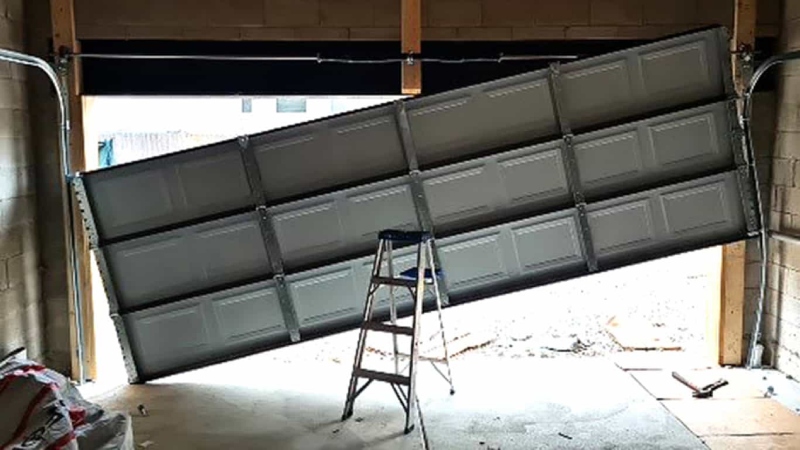
One minute the door is rolling up like always. The next it’s hanging crooked, wedged at an angle, or making a grinding sound as a roller pops out of the track. It’s tempting to give it a push, shove the roller back in, and hope for the best.
Don’t. An off-track garage door is one of the more dangerous problems a homeowner can face. The door weighs well over 100 pounds, and once it’s out of its tracks, there’s very little holding it in place.
Here’s how to recognize an off-track door, what usually causes it, what to do right away, and what a proper repair looks like.
How to Tell Your Door Is Off Track
Sometimes it’s obvious, and sometimes it starts small. Watch for:
- One or more rollers outside the track, often near the top curve or the bottom of the vertical track
- A door that hangs crooked, with one side higher than the other
- Gaps between panels, or a section bowed or bent outward
- Grinding, scraping or popping as the door moves
- A door that stops partway and won’t go up or down
- Tracks that look bent, twisted or pulled away from their brackets or the wall
If the door is only starting to rub or wobble, you may be catching the problem early. If rollers are already out of the track or the door is crooked, treat it as urgent.
What Knocks a Door Off Track
A few causes account for most off-track doors:
| Cause | What happens |
| Vehicle impact | Backing into a partly open door, or clipping the track, bends the track or pushes rollers out |
| Broken or loose cable | When a lift cable snaps or slips off its drum, one side of the door drops, and the door twists out of its tracks |
| Broken spring | The door becomes unbalanced, and the opener may pull it unevenly or jerk it out of alignment |
| Worn or broken rollers | Cracked wheels or failed bearings can jump the track or bind inside it |
| Loose or bent hardware | Track brackets and bolts loosen over time from vibration, letting the track shift |
| Obstructions | Objects in the track, or something caught under the door, can force rollers out |
| Opener force set too high | An opener set to push too hard can keep driving a door that’s binding, forcing it off track instead of reversing |
Often, an off-track door is the end result of a smaller problem, such as a fraying cable or a worn roller, that went unnoticed.
Why It’s Dangerous, and What to Do Right Now
The tracks don’t just guide the door. They help hold it up. Once rollers leave the track, the door’s weight is supported by fewer points, often at odd angles. Springs and cables may still be under heavy tension. A door in that state can shift, drop or swing suddenly.
If your door is off track:
- Stop using the opener. Unplug it if you can do so without standing under the door. Running it can bend the tracks further, damage panels or pull the door down.
- Don’t try to force the door up or down, and don’t try to push rollers back into the track by hand.
- Keep everyone clear. Keep people, pets and cars away from the doorway and the area under the door.
- Don’t pull the emergency release on a door that’s crooked or partly open. Without the opener holding it, the door can fall.
- Leave springs, cables and brackets alone. They’re under tension that can cause serious injury.
- Call a garage door technician, and tell them the door is off track and whether it’s open, closed or stuck partway.
If your car is trapped, let the company know. It’s usually treated as a priority.
What a Proper Repair Involves
Putting the rollers back in the track is only part of the job. A thorough repair should also find out why the door came off track in the first place. A technician will typically:
- Secure the door before working on it, so it can’t shift or fall
- Release or control spring tension as needed, using the right tools
- Inspect and straighten or replace bent track sections, and tighten or replace track brackets
- Replace damaged rollers, hinges or panels, especially any that were bent in the incident
- Check and replace cables, and make sure they’re wound correctly on the drums
- Inspect the springs and replace them if they’re broken, worn or the wrong size
- Rebalance the door, so it moves evenly and stays in place when lifted halfway by hand
- Adjust the opener’s force and travel settings, and test the safety sensors and auto-reverse
If the door has been badly bent, a technician may recommend replacing damaged sections or, in some cases, the whole door. A good one will explain what failed and why, and show you the damage, before recommending anything major.
Keeping It From Happening Again
Most off-track doors can be prevented with a few habits:
- Wait for the door to open fully before backing out or pulling in, and keep an eye on clearance with trucks, roof racks and trailers.
- Listen and look for early signs. Grinding, wobbling rollers, a door that shudders, or a cable that looks frayed are all worth a call before they become a bigger problem.
- Keep the tracks clean and clear. Wipe out dirt and debris, and don’t grease the tracks.
- Tighten loose hardware on hinges and track brackets twice a year. Leave the bottom brackets, which are under cable tension, to a pro.
- Lubricate rollers, hinges and springs with a garage-door spray.
- Test the balance and auto-reverse a few times a year, and never turn up the opener’s force to make a struggling door close.
- Schedule an annual inspection, where a technician can check cables, rollers, springs, tracks and opener settings before something gives way.
A door that runs straight and smooth is a door that stays on track. And if yours does come loose, the safest thing you can do is stop, step back and let a professional take it from there.
About the Author
This article was written by the team at Rightly Garage Doors, a residential garage door company based in Salida, Colorado, serving homeowners across South-Central Colorado. With more than 12 years of hands-on experience, the team repairs and installs garage doors, springs, cables and openers, and starts every repair with a 29-point inspection of the whole system.
Click here for more details.