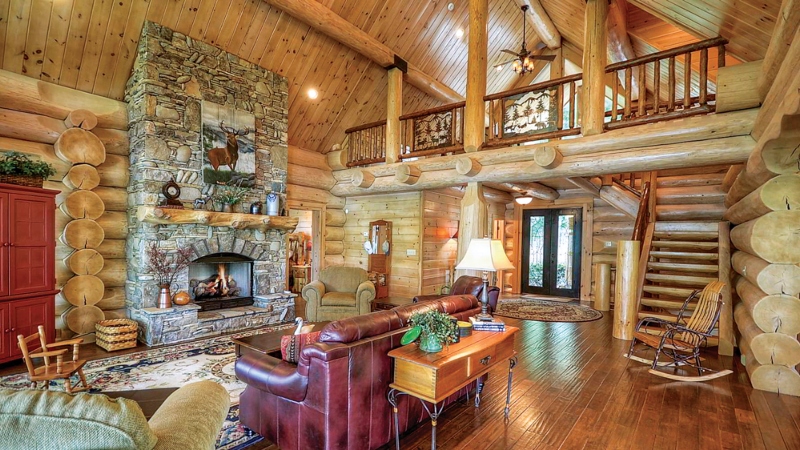
A well-built log home in February is a strange experience for anyone who grew up in a stick-framed house. The walls feel warm to the touch, the temperature drifts slowly instead of lurching every time the furnace cycles, and the place seems to hold its mood. Then you meet someone whose cabin is drafty and ruinous to heat, and the obvious question follows.
Prospective owners ask some version of “are log homes insulated?” before they ask about anything else. The honest answer is that logs provide real thermal resistance, though they are not insulation the way a batt of fiberglass is insulation, and the difference between a comfortable log home and a cold one usually has little to do with the species of tree.
Several factors stack up, and they do not carry equal weight. Here is what each one actually contributes.
The Logs Themselves Do Some of the Work
Wood resists heat flow, but modestly. The Forest Products Laboratory’s work on the thermal conductivity of common woods shows that conductivity shifts with species, density, and moisture content, which is why a dry softwood log outperforms a dense, damp one. Translate that into R-value and a six-inch log wall lands in the single digits. By comparison, DOE’s insulation and air-sealing guidance asks wall assemblies in cold climates to reach roughly R-20 or better.
That gap sounds damning until you account for mass. Thick log walls absorb daytime heat and release it at night, reducing temperature fluctuations and improving warmth beyond their R-value. Thickness matters more than anything else in that equation, so an eight-inch log stores noticeably more than a six-inch one.
Where the Heat Actually Escapes
Air leakage, not conduction, is what ruins most cold log homes. Every horizontal joint between logs, every corner notch, and every spot where a log was drilled for wiring is a potential path, and logs shrink and settle for years after construction, which opens those paths gradually.
The EPA’s ENERGY STAR savings methodology models sealing and insulating as a pair and puts typical whole-house savings near 11 percent nationally, climbing higher in cold zones. In a log home the sealing half does most of the lifting. Gaskets, splines, chinking, and proper sealant in the lateral grooves are not cosmetic details. They are the envelope.
Settling is the part nobody warns you about. A log wall can lose several percent of its height over the first few years, so door and window bucks need slip joints and the sealing has to be rechecked once the house has moved. Skip that follow-up and a tight home turns leaky on a slow timer.
The Roof and Windows Carry More Weight Than Expected
Log walls get the attention while the roof quietly sets the heating bill. Heat rises, and roofs cover large areas in log homes, making higher insulation levels practical without matching the walls’ R-value. Cold climates often require R-49 insulation or higher, while vaulted log ceilings need insulation integrated directly into their roof assemblies.
Windows are the other soft spot, and log homes tend to have generous ones because the view is usually the reason somebody built there. A large glazed area with mediocre units will outweigh any argument about log thickness.
Construction Quality Decides the Rest
Two identical log packages in the hands of two crews produce two different buildings. Log-to-log fit, corner joinery, settling allowance above windows and doors, flashing details, and the sequencing of the sealing work all come down to execution rather than materials.
The ordinary logic behind energy-smart upgrades applies here too: find and close the leaks first, then add material where it will do the most good. Ask a builder for a blower door result on a finished home and you will learn more in one number than in an hour of brochure reading.
Comfort Comes From the System
So logs insulate, partially, and they moderate indoor temperature better than their R-value suggests. What they do not do is forgive sloppy assembly, a thin roof, or a wall of cheap glass facing north.
If you are evaluating a log home, put your attention on the joints, the roof assembly, the window package, and the builder’s track record. Those four things explain nearly every difference between the log home that feels like a sweater and the one that feels like a tent.
Logs are a good wall. The rest of the house still has to show up. You can also find Decorade House for more informations.