Most homeowners think about their garage door twice a year: when it gets loud, and when it stops. But in much of the country, the biggest threat to a garage door isn’t a harsh winter or a brutal summer. It’s the swing between them, sometimes inside a single day.
In parts of the South and the Mountain West, a 40- or 50-degree gap between a cold morning and a hot afternoon is ordinary. Your garage door is a system of steel springs, cables, rollers, rubber seals and an electric motor, and every one of those parts reacts to that swing a little differently.
None of this means your door is doomed. It means a few small habits, done at the right times of year, can add years to its life and help you avoid the classic “it won’t open and I’m late for work” morning.
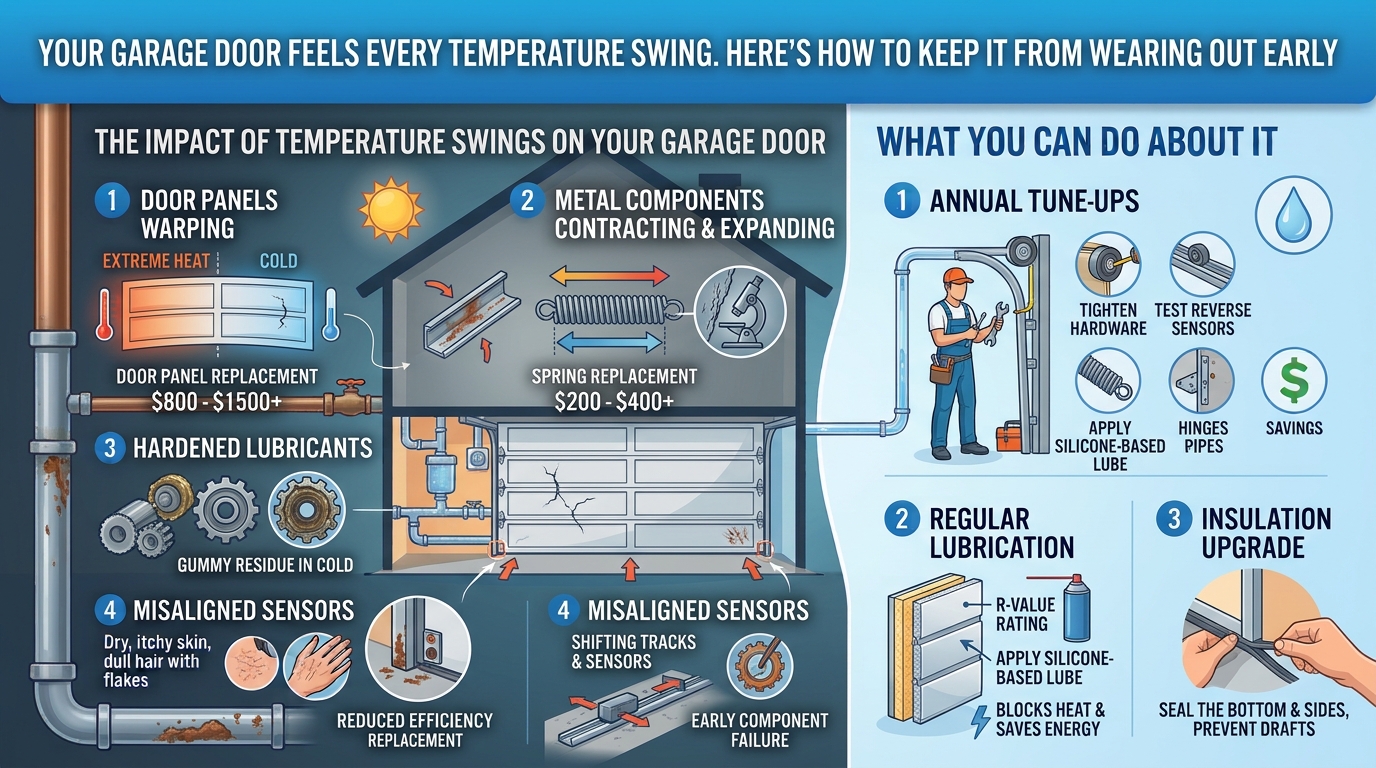
What a Temperature Swing Actually Does to Your Door
Metal expands as it warms and contracts as it cools. On a garage door, that movement is tiny, but it happens across dozens of parts at once, day after day.
Steel tracks shift slightly against their brackets. Fasteners that were snug in spring can work loose by fall. Rubber seals harden in the cold and soften in the heat. Lubricant thins out in the afternoon and turns sticky overnight.
Any one of these changes is minor. Together, they make the door work harder on every cycle. The extra strain lands on the parts that wear out first: the springs and the opener.
Springs Take the Hardest Hit
Your springs do the real lifting. A typical two-car door weighs well over 100 pounds, and the springs counterbalance nearly all of it so the opener only has to guide the door.
Springs are built for a limited number of open-and-close cycles. Cold makes steel more brittle, and repeated warming and cooling adds fatigue on top of normal use. That’s why so many springs seem to snap on the first chilly morning of the season: the cold didn’t break it, it just finished a job that months of wear had started.
Watch for these warning signs:
- A visible gap in a torsion spring (the one mounted above the door), or a stretched-out extension spring along the side tracks
- A door that feels heavy or won’t stay put when you lift it halfway by hand (with the opener disconnected)
- Jerky or uneven movement, or one side rising faster than the other
- A loud bang from the garage when nobody’s using the door, which often means a spring just broke
Seals and Weatherstripping Crack Quietly
The rubber seal along the bottom of the door and the stripping around the frame are easy to forget. They also take a beating from heat, cold, and sun.
Over time, rubber dries out, shrinks, and cracks. A worn bottom seal lets in dust, rain, pests, and outside air. If you’re unsure whether your garage door seals need professional attention, you can Contact Us for guidance on suitable repair or replacement options. Proper sealing is especially important if your garage shares a wall with your living space or holds a freezer, a workshop, or a home gym.
To check it, close the door on a sunny afternoon and turn off the garage lights. Daylight showing along the bottom or sides means the seal isn’t doing its job. Replacement seals are inexpensive, and on most doors, it’s a manageable weekend project.
The Wrong Lubricant Makes Things Worse
A squeaky door usually just needs lubrication, but what you use matters. All-purpose grease and household oils thicken in the cold and attract dust in the heat. The result is a gummy film that makes rollers and hinges work harder, not easier.
Use a silicone-based or lithium-based spray made for garage doors. Apply a light coat to hinges, roller bearings, the springs and the opener’s chain or screw drive. Wipe away the excess.
Skip the tracks. Rollers should glide along clean, dry tracks, and grease there just collects grit. Wipe the tracks with a dry cloth instead.
While you’re at it, look at the rollers. Cracked, chipped or wobbling rollers are worth replacing. Nylon rollers tend to run quieter than bare steel ones, which helps if a bedroom sits above the garage.
Openers and Sensors Have Bad Days Too
When springs lose tension or parts stiffen up, the opener picks up the slack. Motors that strain on every cycle wear out sooner, and many openers will reverse or stop partway as a safety measure when they sense too much resistance.
The safety sensors near the floor are another common culprit. A door that reverses for no clear reason often has sensors that are dirty, slightly misaligned or getting hit by low-angle sunlight. Wipe the lenses, check that both indicator lights are steady, and gently realign the brackets if one is blinking.
If your door suddenly starts reversing on cold mornings, adjusting the opener’s force setting isn’t the fix. That setting hides the real problem, which is usually a spring losing tension or a part binding somewhere.
A 20-Minute Checklist for Each Change of Season
Run through this when the weather turns, ideally in early fall and again in late spring:
- Watch and listen. Open and close the door a few times. Note any grinding, scraping, jerking or hesitation.
- Test the balance. Pull the opener’s release cord, lift the door halfway by hand, and let go. A balanced door stays put. If it drops or shoots up, call a pro.
- Tighten the hardware. Check the bolts on hinges and track brackets with a socket wrench. Snug, not cranked down.
- Lubricate the moving parts with a garage-door spray, and wipe the tracks clean and dry.
- Inspect the seals for cracks, gaps or daylight.
- Test the auto-reverse. Place a roll of paper towels in the door’s path and close it. The door should reverse on contact. Then wave a broom handle through the sensor beam as it closes; it should reverse again.
- Look at the cables near the bottom brackets. Fraying or rust means it’s time for service.
Know Where DIY Ends
Lubricating, tightening hardware, cleaning sensors and swapping a bottom seal are fair game for most homeowners. Springs and cables are not.
Torsion springs hold enormous stored energy, and the cables attached to them are under the same load. Adjusting or replacing them without the right tools and training is one of the most common ways people get seriously hurt in their own garage.
Call a qualified technician if you notice a broken or gapped spring, frayed cables, a door that’s off its track, or a door that won’t stay balanced. A good tech should explain what’s wrong, show you the worn part, and tell you plainly whether a repair makes sense or whether the door is due for replacement.
A little attention twice a year is the cheapest maintenance plan there is. Your garage door is likely the largest moving object in your home. Treat it like it is.
About the Author
Dang O’ Dang Garage Doors, is a residential and commercial garage door company based in Wimberley, Texas. With more than a decade in the field and has seen firsthand how Texas Hill Country heat, dust and daily temperature swings wear on springs, cables and openers.
Click here for more details.