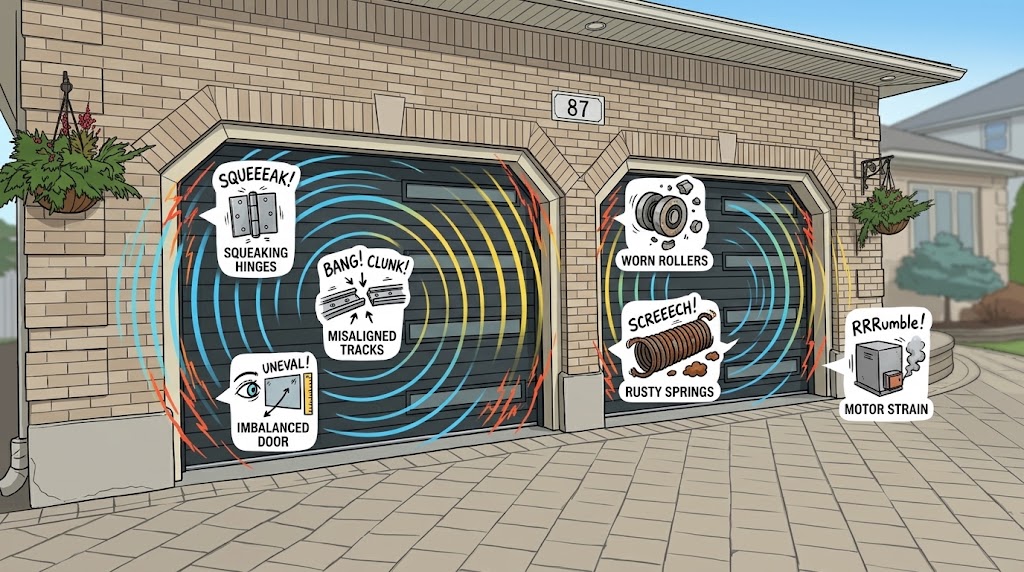
Every garage door makes some noise. But when yours starts grinding, squealing, popping, or banging, it’s not just an annoyance for whoever sleeps above the garage. It’s usually a specific part asking for attention. Learning to read those sounds can save you money. Many noisy doors need nothing more than lubrication or a few tightened bolts. Others are giving you an early warning before a part fails.
Here’s how to decode the most common garage door noises, what you can fix yourself, and which sounds mean it’s time to stop using the door. If the noise suggests a more serious mechanical issue, don’t risk attempting complicated repairs yourself. Instead, visit the Contact Us page to connect with professionals who can help identify the problem and recommend a safe solution.
A Quick Sound Guide
Open and close the door a few times and listen closely. Try to notice where the sound comes from and when it happens: at the start, in the middle of travel, or at the end.
| What you hear | Most likely cause | What to do |
| Squeaking or squealing | Dry hinges, rollers or springs | Lubricate with a garage-door spray |
| Grinding or scraping | Worn rollers, or a bent or dirty track | Clean the tracks; replace worn rollers |
| Rattling | Loose nuts, bolts or brackets | Tighten hardware (not bottom brackets) |
| Popping or creaking | Dry springs, or panels flexing | Lubricate springs; have balance checked |
| Humming with no movement | Opener motor or gear trouble | Call a technician |
| Loud bang, door won’t lift | Broken spring | Stop using the door; call a pro |
| Slapping or chain rattle | Loose or worn opener chain | Have tension adjusted, or upgrade to a belt drive |
Quick Fixes You Can Do This Weekend
These take about an hour and solve a surprising number of noisy doors:
- Tighten the hardware. A door vibrates every time it moves, and bolts on hinges and track brackets work loose over time. Snug them with a socket wrench, but don’t overtighten. Leave the bottom brackets alone, since they’re attached to cables under tension.
- Lubricate the right parts. Use a silicone or lithium spray made for garage doors on hinges, roller bearings, springs and the opener’s chain or screw. Skip WD-40 as a lubricant. It’s mainly a cleaner and can dry out parts over time.
- Clean the tracks. Wipe out dirt, cobwebs and old grease with a dry cloth. Tracks should be clean and dry, not greased.
- Look at the rollers. Cracked, chipped or wobbly rollers are a common source of grinding. They’re worth replacing, though rollers attached to the bottom bracket should be left to a technician.
- Check the weatherstripping. A worn bottom seal can slap or scrape against the floor as the door closes.
Upgrades That Make a Door Quieter for Good
If your door is still loud after basic maintenance, a few upgrades can make a dramatic difference:
- Nylon rollers. Many older doors use bare steel rollers that clatter along the track. Sealed nylon rollers with ball bearings run much more quietly and smoothly.
- A belt-drive opener. Chain-drive openers are durable but noisy. Belt-drive models use a reinforced rubber belt and are among the quietest options, which matters most when a bedroom sits above or beside the garage.
- Anti-vibration pads. Rubber isolators placed between the opener and the ceiling mount keep motor vibration from traveling through the framing.
- An insulated door. Insulated doors, built with two or three layers, are sturdier and dampen sound far better than a single sheet of steel. They also help keep the garage more comfortable year-round.
- New springs. Worn springs make the opener work harder and the door move unevenly. Fresh, properly sized springs often quiet a door and take strain off the opener.
Sounds That Mean Stop and Call a Pro
Some noises mean a part has already failed or is about to. Stop using the door and call a trained technician if you hear:
- A sudden, loud bang from the garage, often followed by a door that won’t lift. This usually means a torsion spring has snapped.
- A snapping or twanging sound paired with a door that hangs crooked. A cable may have frayed or come off its drum.
- Grinding at the top or bottom of travel, especially with a door that sticks or jumps. It can mean a door is coming off its track.
- A motor that hums or clicks while the door doesn’t move. The opener may be failing, or it may be straining against a door that’s out of balance.
Springs and cables hold the door’s full weight under serious tension, so these are never DIY repairs. A good technician will find the source of the noise, show you the worn part and explain your options before doing any work.
The bottom line: a quiet door is usually a healthy door. Listen when yours starts talking.
About the Author
This article was written by the team at Garage Doors Today Greenville, a locally owned, licensed South Carolina residential garage door contractor. With more than 22 years of hands-on experience, the team repairs and installs garage doors, springs, cables and openers for homeowners across Greenville and the Upstate.
Click here for more details.