Most people blame the room. The lounge is too narrow. The open-plan space is too big. The window is in a silly place. So they move the sofa for the fourth time, and nothing really changes.
Here’s the thing, though. Very often the room is fine. It’s the sofa that isn’t working.
A three-seater pushed against the longest wall is what most of us grew up with, so it feels like the safe choice. In a small flat or a wide open-plan layout, it rarely is. An L shape sofa works differently. It uses the corner, marks out space, and seats more people without you squeezing in another chair. If your living room has never quite felt right, this could be why.
Why Most Sofa Layouts Feel Wrong in Small and Open-Plan Rooms
Picture a typical terraced house lounge or a new-build flat. A sofa sits on one wall, an armchair angles toward the window, a coffee table sits in the middle, and the TV sits opposite. On paper, it’s a perfectly normal setup.
In real life, you’re stepping round the armchair every time you close the curtains. And the corner behind it? It collects nothing but dust and the odd charging cable. Every separate piece needs its own breathing room, and in a small space those bits add up fast.
Open-plan rooms have the opposite problem. There’s plenty of space but not much shape to it. The sofa floats in the middle with no real purpose, the kitchen spills into the lounge, and the area feels more like a showroom than somewhere to collapse at the end of the day.
Two very different problems. Surprisingly often, the same fix.
L Shape Sofa, L Couch or Corner Sofa: Is There a Difference?
Short answer: not really. In UK shops, “corner sofa” is the name you’ll hear most. “L shape sofa” simply describes what it looks like: two sections meeting at a right angle. “L couch” is the same idea in a more American way, and you’ll see it a lot online.
The real differences are in how they’re built. Some have two sides of equal length. Others have one long side and a shorter chaise end for stretching your legs out. Some are modular, so you can rearrange them later if you move. Knowing which type you need matters far more than the label.
How an L Shape Sofa Makes a Small Living Room Work Harder
In a small room, every bit of floor has a job to do. This is where the L shape earns its place, in three simple ways.
It Puts the Dead Corner to Use
Corners are the most wasted space in most living rooms. Hardly anything fits them, so they end up empty or home to one lonely plant. An L shape sofa tucks straight into that corner and turns it into seating, which frees up a surprising amount of floor in the middle.
More Seats, Fewer Pieces
One L couch usually seats as many people as a sofa and an armchair put together, sometimes more. Fewer pieces means fewer legs, fewer awkward gaps, and fewer things to walk around. The room looks calmer straight away, and it’s easier to keep tidy.
Compact Sizes That Don’t Swallow the Room
A lot of people worry a corner sofa will be too big. Some are, to be fair. But plenty are made with smaller homes in mind, with slimmer arms, lower backs and shorter sides that still give that cosy, wraparound feel.
If you’ve got an awkward corner and aren’t sure what will fit, look through a range of L shape sofas in different sizes before deciding. Seeing the widths, seat depths and fabrics side by side makes it much easier to picture the right one, rather than guessing from a single photo.
How an L Shape Sofa Creates Zones in Open-Plan Spaces
Open-plan living feels dreamy until you try to furnish it. The right sofa gives the space structure without a single wall, and a few small tricks make all the difference.
The Back of the Sofa as a Soft Divider
In an open-plan room, you don’t want walls, but you do want a sense of where one area stops, and the next begins. Turn the long side of an L shape sofa so its back faces the kitchen or dining table, and you’ve done exactly that. It quietly says, “This bit is the living room,” without blocking any light.
Pulling It Away From the Wall
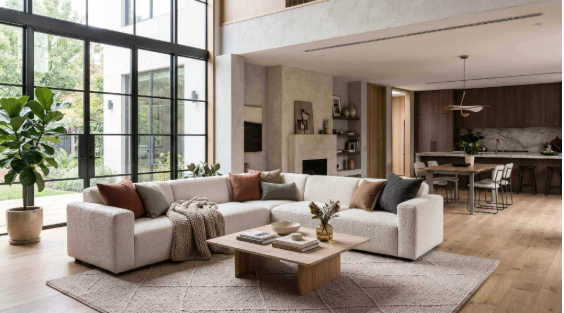
Pushing every piece against the walls is a habit, not a rule. In a bigger space, bringing the sofa forward a little creates a walkway behind it and makes the seating look planned rather than parked. L shaped sofas are especially good at this because they look finished from more than one side.
Pinning the Area Down With a Rug and Lighting
Even a good sofa can look lost on its own. Put a large rug underneath, big enough for at least the front legs, and the space makes sense. A floor lamp in the inside corner of the L, or a pendant over the coffee table, finishes the job. Evening light matters more in open-plan homes than most people expect.
What to Check Before You Buy
Falling for a sofa online is easy. Making sure it works in your home takes a little homework, so run through these four checks before you order.
Measure the Room and the Way In
Measure both walls, then mark the sofa’s footprint on the floor with masking tape. Leave it a day or two and see how it feels to walk around. Then measure the front door, hallway and any tight turns on the stairs. Plenty of lovely sofas have gone straight back on the van because they couldn’t get past the bannister.
Left-Hand or Right-Hand?
This catches a lot of people out. Usually the “hand” means the side the chaise sits on when you’re standing in front, facing the sofa. Not every retailer uses the same rule, so always check the diagram. Think about where the window, TV and door are and which side you’d naturally put your feet up.
Pick a Fabric That Suits Your Life
Got kids, a dog, or a habit of eating dinner on the sofa? Go for something hard-wearing and easy to clean. Textured weaves hide marks far better than flat fabrics. Pale velvet and muddy paws aren’t a happy mix. Faux leather wipes clean in seconds, though it can feel chilly in winter.
Colour and Legs Make a Difference
In a small room, lighter shades like soft grey, oatmeal or warm beige help the space feel bigger. A sofa on raised legs shows more floor underneath, which tricks the eye into reading the room as larger. Chunky, low-slung designs suit bigger rooms better.
Once you’ve got your measurements and know which side you need, the easiest next step is to compare a few options before you buy sofa online. Checking sizes, fabrics and prices in one place beats trawling through ten websites or settling for the first one that looks alright.
A Few Mistakes Worth Avoiding
Even a well-chosen L shape sofa can feel wrong if it’s set up badly. These slip-ups come up again and again, and they’re all easy to avoid.
- Going too big. If you can’t walk around it comfortably, it’s too big, however good it looked in the showroom.
- Pointing the chaise into the walkway. The long end should sit along a wall or face into the room, not stick out into the main route from the door to the kitchen.
- Arranging everything around the TV. You’ll watch telly, sure, but you’ll also chat, read and host friends. The L shape angles people towards each other, so don’t undo that by facing every seat at the screen.
- Forgetting the small stuff. A side table within arm’s reach of each end saves balancing mugs on the armrest. It sounds minor until you live with it.
Final Thoughts
If your living room feels cramped, or your open-plan space feels like it’s missing something, the answer usually isn’t more furniture. It’s less about arrangement.
A good L shaped sofa fills the corner, seats the whole family, marks out the living area, and gives the room a natural centre. Measure carefully, pick the right side, and choose a fabric that copes with real life, and you’ll probably wonder why you didn’t switch years ago.
FAQs
Is an L Shape Sofa a Good Idea for a Small Living Room?
Usually, yes. Because it uses the corner, it often takes up less usable floor space than a sofa and armchair combined. The exception is a very narrow room, where a long chaise can block the walkway. There, a compact model with a short return side is safer.
How Much Space Do I Need for an L Couch?
Start with the room, not the sofa. Many compact corner sofas measure around 200 to 240cm on the longer side, while bigger family ones go past 300cm. Whatever you choose, keep a clear walking route of about 75 to 90cm, plus room in front for a coffee table.
Will an L Shape Sofa Fit Through My Front Door?
Most will, because they arrive in sections rather than one huge piece. Still, check the width of every door and hallway, and compare it with the biggest section. Tight turns on the stairs are where deliveries most often go wrong, so measure those too.
Can I Swap My L Shape Sofa From Left-Hand to Right-Hand Later?
It depends on the design. Some have a reversible chaise or modular pieces that connect either way, which are handy if you rent or might move soon. A fixed corner sofa can’t be switched, so a reversible model is worth a look.
Can an L Couch go in the middle of the room?
Yes, and in open-plan spaces it often looks better there. Just make sure the back is properly finished, because people will see it. A slim console table or low shelf behind it gives the back a purpose and a spot for a lamp.
How Do I Stop an L Shape Sofa From Looking Bulky?
In a small room, go for raised legs and slim arms. Keep cushions to a handful in two or three colours rather than a pile in every pattern. A round or oval coffee table helps too, because it softens the sofa’s hard right angle and is easier to walk around.
Click here for more details.