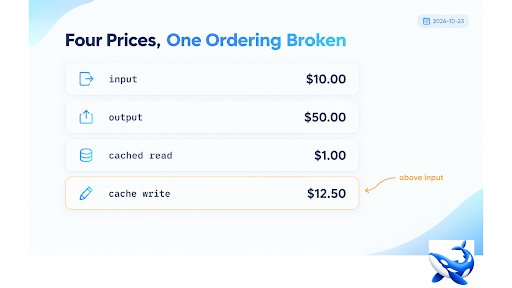
Four numbers sit on one price row: $10.00 input, $50.00 output, $1.00 cached read and $12.50 cache write per million tokens [OURS]. The last of them is the one that decides whether caching pays at all, because writing a prefix costs 1.25 times what sending the same tokens as ordinary input costs. That row is what answers the claude fable 5 price query — 152 impressions over 28 days at position 8.4, with no click taken. The card it sits on is served by OrcaRouter.
The write premium, and why the ordering broke
Most rate cards order themselves: output costs most, input in the middle, cached input least. Claude Fable 5 has a fourth number, and it is priced *above* input rather than below it.
| Line | Rate per million | Against input |
| Input | $10.00 | 100% |
| Cached read | $1.00 | 10% |
| Cache write | $12.50 | 125% |
The 1.25× write premium is not a Fable-only quirk. Claude Opus 4.6 charges $6.25 against $5.00 of input, and Claude Sonnet 5 charges $2.50 against $2.00 — the same 125 percent in both cases [OURS]. It is the shape of this family’s cache: you pay a quarter more to put a prefix in, and a tenth as much to read it back.
The arithmetic that matters is the break-even. Writing one million tokens costs $12.50 instead of $10.00, a premium of $2.50. Reading that million back costs $1.00 instead of $10.00, a saving of $9.00 per reuse. One reuse repays the premium twice over; the second reuse is pure margin.
So the caching decision on this card is not “is caching worth it” — it is “will this prefix be read at least once more”.
What a cached prefix costs across a day
Take a 1,000,000-token instruction block, unchanged across requests, and twenty calls against it.
| Per call | Twenty calls | |
| No cache | $10.00 | $200.00 |
| Cache, written once then read 20 times | $12.50 + 20 × $1.00 | $32.50 |
The cached version is 83.8 percent cheaper. But run the same comparison on a single call and the sign flips: $10.00 uncached against $12.50 written and never read, so a one-shot request pays a quarter more for the cache entry than it would have paid for plain input.
That is the whole decision. A prefix used once is a 25 percent penalty. A prefix used twice is already cheaper than no cache at all, and every reuse after that costs a tenth of input.
Nineteen rows, two publishers
The benchmark table is unusually long — nineteen rows — and it is split almost evenly between two publishers. Twelve come from the independent evaluator, seven from Anthropic itself [OURS].
The independent half is the saturated half: GPQA Diamond 92.6, τ²-Bench 98.54, GPQA’s sibling Humanity’s Last Exam 55.5, terminalbench_v2_1 84.64, Long-Context Recall 82.33, IFBench 63.47, AA Intelligence 49.6, AA Coding 76.5, SciCode 61, TerminalBench Hard 62.88, tau_banking 38.14, and terminalbench_v4_0 at 42.42.
The vendor half reads much lower: OSWorld-Verified 85, SWE-Bench Pro 80.3, Blueprint-Bench 2 38.6, GDPval.pdf 29.8, FrontierCode (Diamond) 29.3, AutomationBench 17.4, Legal Agent Benchmark 13.3.
A reader who takes the first half sees a model scoring in the nineties on knowledge and near a hundred on tool use. A reader who takes the second sees a model failing seven tasks out of ten. Neither is wrong, and neither is the whole model: the two publishers chose different difficulty bands, and the card prints both without reconciling them.
One row is worth singling out because it is the only one here that is both hard and recent. terminalbench_v4_0 at 42.42 is the second-highest reading of that benchmark in this batch, behind Claude Fable 5.1’s 52.02 [OURS]. Most cards in the catalogue score in the single digits to low thirties on version 4.0. A 42 on the generation that floors everything else says more about agentic capability than any of the saturated rows above it.
Latency, on a card that costs ten dollars to read
Seven-day telemetry puts the median at 2,927 ms to first token and p95 at 10,000 ms — the recording ceiling rather than a measured value [OURS]. The error rate is 0.61 percent, and the card has served 1,172,127 tokens in the window.
Output speed is 74.3 tokens per second. That is the number that separates a frontier model from a fast one at the same price: the cheap cards in this catalogue run several hundred tokens per second, and a 1,000-token answer here takes about thirteen seconds of generation after the first token arrives.
For workloads that use long cached prefixes, such as a document corpus, codebase, or fixed policy block, the cache spreads the 2.9-second startup cost across requests, leaving slow generation as the only real cost. For a chat interface, both numbers are visible to the user on every turn.
The takeaway
Claude Fable 5 prices at $10.00 input, $50.00 output, $1.00 cached read and $12.50 cache write per million tokens, with a 1,000,000-token context and a 128,000-token output ceiling [OURS].
The fourth number is the one to plan around. A cache entry costs a quarter more than the input it replaces, so the card rewards repetition and penalises one-shot requests — and with a 90 percent read discount, a single reuse already covers the penalty.
Sourcing note: the four rates, the cache ratios, the context and output limits, the nineteen benchmark values with their `source` fields, and the seven-day p50, p95, error rate, output speed and token count are read from the OrcaRouter public model card for `anthropic/claude-fable-5` on 2026-10-23 [OURS]. The evaluator conducted its own runs for rows tagged artificialanalysis.ai [INDEPENDENT], while the vendor published the figures for rows tagged anthropic.com [VENDOR].The impression and position figures come from Search Console for the 28 days to 2026-10-21 [OURS]. The break-even arithmetic, the per-day cost table and the comparison to sibling cards are our own. The text does not name any competing gateway or inference marketplace. All values checked 2026-10-23.
Click here for more details.