Cast Iron Drain Pipes in Toronto: Common Problems, Repair vs. Replace
If your Toronto home was built several decades ago, there is a decent chance some of the plumbing hidden behind the walls or underneath the basement floor is made from cast iron. It was a popular material for drain and waste pipes because it was strong, durable and relatively quiet compared with some modern plumbing materials. But when those older pipes start showing signs of trouble, homeowners may need sewer repair or a sewer camera inspection to figure out what is actually happening below the surface. A little rust or a slow drain might not seem like a big deal at first, but cast iron can deteriorate from the inside out.
So, what should you do when you start noticing signs of trouble? Is cast iron drain pipe repair enough, or is it time to replace the entire system?
The right solution depends on the pipe’s condition, the location of the damage, and the extent of the deterioration.
Why Do Cast Iron Pipes Fail?
Cast iron is tough, but its biggest enemy is corrosion.
Every time wastewater moves through a drain pipe, the interior is exposed to moisture and various materials. Over many years, the inside of the pipe can gradually rust and deteriorate. The process is usually slow, which is why homeowners may not realize there is a problem until the pipe is already significantly weakened.
One of the more common cast iron drain problems is corrosion around the bottom portion of the pipe. As the interior surface deteriorates, it can become rough and uneven. That rough surface can catch debris, contribute to blockages, and reduce the effective diameter of the pipe.
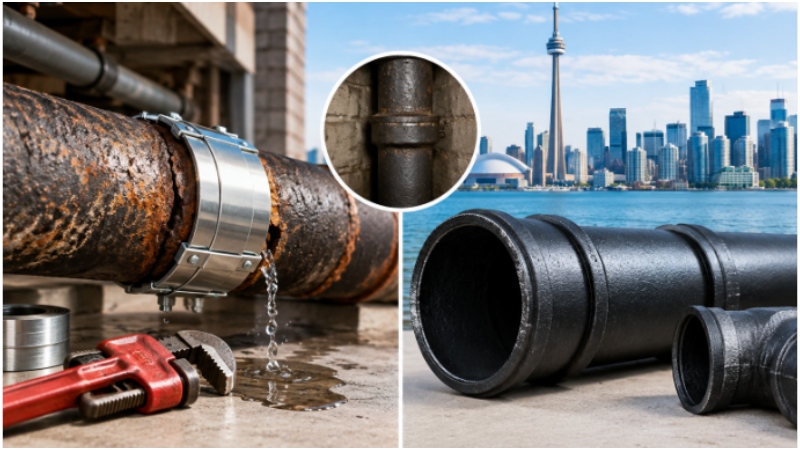
Eventually, the corrosion can become severe enough to create a pinhole leak in a cast iron drain pipe.
And that is where things can get messy.
A tiny hole might not seem like a major emergency, but wastewater leaking into a wall, ceiling or basement can cause much bigger problems if it goes unnoticed.
Common Signs of Failing Cast Iron Drain Pipes
Cast iron usually gives you some warning before it completely fails. The signs are not always obvious, though, especially when most of the plumbing is hidden.
Keep an eye out for:
- Slow drains throughout the house
- Recurring drain blockages
- Sewage or musty smells
- Water stains on ceilings or walls
- Damp areas around exposed pipes
- Visible rust or flaking on cast iron
- Cracks or damaged pipe joints
- Unexplained moisture in the basement
- A cast iron waste pipe leaking around a connection
- Gurgling sounds coming from drains
A single slow drain does not automatically mean your cast iron plumbing is failing. A localized blockage could be the culprit.
But if several drains are having problems at the same time, particularly in an older Toronto home, it is worth investigating further.
How Long Do Cast Iron Pipes Last?
There is no exact expiration date for cast iron plumbing.
In general, cast iron drain and waste pipes can last several decades, and some installations have remained in service for 50 years or more. Actual lifespan depends on factors such as installation quality, soil conditions, water chemistry, pipe thickness, usage, and the amount of corrosion that has occurred.
That is why asking “How long do cast iron pipes last?” does not give you a simple yes-or-no answer.
A 60-year-old cast iron pipe is not necessarily ready to fail tomorrow. On the other hand, an older pipe showing extensive corrosion should not be ignored simply because it has not leaked yet.
A pipe’s overall condition is more important than its age by itself.
Rusty Cast Iron Pipes: When Is Rust a Problem?
Seeing a little surface rust on an exposed cast iron pipe is not necessarily a reason to panic.
The concern is when the corrosion is deeper.
If the pipe is heavily rusted, flaking, pitted, or showing areas that look unusually thin, the structural integrity of the pipe may already be compromised. This is particularly important with older horizontal drain lines, where corrosion can develop along the bottom of the pipe.
A plumber can inspect the exposed sections, but the bigger challenge is figuring out what is happening inside the pipe and in sections that are underground or behind finished walls.
A sewer camera inspection can provide valuable insight at this stage.
Sewer Camera Inspection Can Tell You More
Instead of immediately digging up floors or opening walls, a camera can be inserted into the drain or sewer line to see what is actually happening inside.
A camera inspection can help identify:
- Corrosion
- Cracks
- Broken sections
- Root intrusion
- Blockages
- Separated joints
- Interior buildup
- Areas where the pipe has deteriorated
This information makes the repair-versus-replacement decision much easier.
For example, if most of the pipe is in reasonable condition and there is one localized problem, replacing a small section may make sense.
If the camera shows extensive corrosion throughout the line, patching one leak may only delay the inevitable.
Repair or Replace Cast Iron Drain Pipes?
This is probably the biggest question homeowners have.
And honestly, there is no universal answer.
When Repair May Make Sense
Cast iron drain pipe repair may be appropriate when the damage is limited to a relatively small area.
For example, a single damaged joint or isolated section may be repaired without replacing the entire drain system. This can be less disruptive and less expensive than a major replacement project.
Repairs can also make sense when the remaining pipe is structurally sound.
The important part is determining whether the problem is actually isolated.
Fixing one leak on a pipe that is corroding from one end to the other is not really solving the underlying problem. It is just buying some time.
When Replacement Is the Better Option
Replacement becomes more attractive when the pipe has widespread corrosion, repeated leaks, multiple damaged sections or significant structural deterioration.
If the cast iron is already failing in several locations, continuing to repair individual spots can become a frustrating cycle. You fix one leak, another one appears a few months or years later.
For some Toronto properties, replacing the old drain line with modern piping can provide a longer-term solution.
However, traditional replacement can involve excavation, removing flooring or opening walls. Depending on where the pipe is located, that can turn a plumbing problem into a fairly substantial renovation project.
That is one reason trenchless options are worth discussing when they are suitable for the situation.
Can You Line Cast Iron Pipes Without Replacing Them?
Sometimes, yes.
Pipe lining can provide an alternative to conventional excavation when the existing pipe is a suitable candidate.
With trenchless pipe lining, the existing pipe is cleaned and prepared before a new liner is installed inside the damaged pipe. Once cured, the liner creates a new pipe within the existing one.
The major advantage is that you may not need to dig up large portions of your property to access the entire sewer line.
But pipe lining is not appropriate for every situation. The existing pipe needs to meet certain structural and dimensional requirements, and severe collapses or certain types of damage may require another approach.
A proper inspection should come before deciding on a trenchless solution.
Cast Iron vs. PVC: What’s the Difference?
PVC has become a common choice for modern drainage systems because it is lightweight, relatively easy to install and resistant to many forms of corrosion.
Cast iron, meanwhile, is much heavier and has a long history of use in residential and commercial plumbing. It is also known for reducing the sound of water moving through the pipes.
Neither material is automatically “good” or “bad.”
The bigger issue for homeowners with older cast iron systems is the condition of the existing pipe. Replacing a healthy cast iron line simply because PVC is newer may not be necessary.
Replacing badly deteriorated cast iron, however, can be a very different conversation.
Grow your social media presence with a reliable SMM panel service designed for efficient and affordable social media management.
Boost your online reach, engagement, and visibility with simple, fast, and convenient solutions.
What’s the Cost to Replace Cast Iron?
There is no single price for replacing cast iron plumbing because the project can vary dramatically from one property to another.
The cost can depend on:
- The length of pipe being replaced
- Where the pipe is located
- How accessible it is
- Whether excavation is required
- Basement or floor construction
- The condition of the existing sewer line
- The replacement method
- Restoration work required afterward
For example, replacing an exposed section in a basement is very different from replacing a sewer line underneath a finished floor.
This is also why getting a quote without properly inspecting the line can be difficult. The leak you can see may be just one part of a larger issue.
What’s the Fastest Way to Fix a Leaking Cast Iron Joint?
If a cast iron joint is actively leaking, the priority is to stop further water damage and have the plumbing assessed.
A temporary repair may sometimes control a localized leak, but it is important to understand why the joint failed in the first place.
If the surrounding cast iron is heavily corroded, replacing or rehabilitating the joint alone may not provide a lasting solution.
And if wastewater is involved, this is not really a “wait and see” situation. Even a relatively small leak can create unpleasant odours, moisture damage, and sanitation concerns.
Are Cast Iron Pipes Common in Toronto?
Yes. Cast iron was widely used in older residential and commercial plumbing systems, so it is not unusual to encounter it in older Toronto properties.
That does not mean every older Toronto home has cast iron throughout its entire drainage system. Homes can have a combination of materials depending on when different plumbing work was completed or renovated.
If you are buying an older property, or you already own one and have started experiencing recurring drainage problems, knowing what type of piping you have can be useful.
It can help you plan maintenance and, more importantly, avoid being surprised by a major failure later.
Is Cast Iron Pipe Repair Worth It, or Should You Just Replace It?
The best answer is: inspect first, then decide.
If the pipe is mostly healthy with one isolated problem, repair may be perfectly reasonable.
If corrosion is widespread, leaks keep coming back or the pipe has lost its structural integrity, replacement or trenchless rehabilitation may make more sense.
There is no prize for replacing a perfectly serviceable pipe, just as there is no prize for repeatedly repairing a pipe that is clearly reaching the end of its useful life.
For Toronto homeowners, the goal should be to find the least disruptive solution that actually addresses the underlying problem.
And that starts with knowing what is happening inside the pipe.