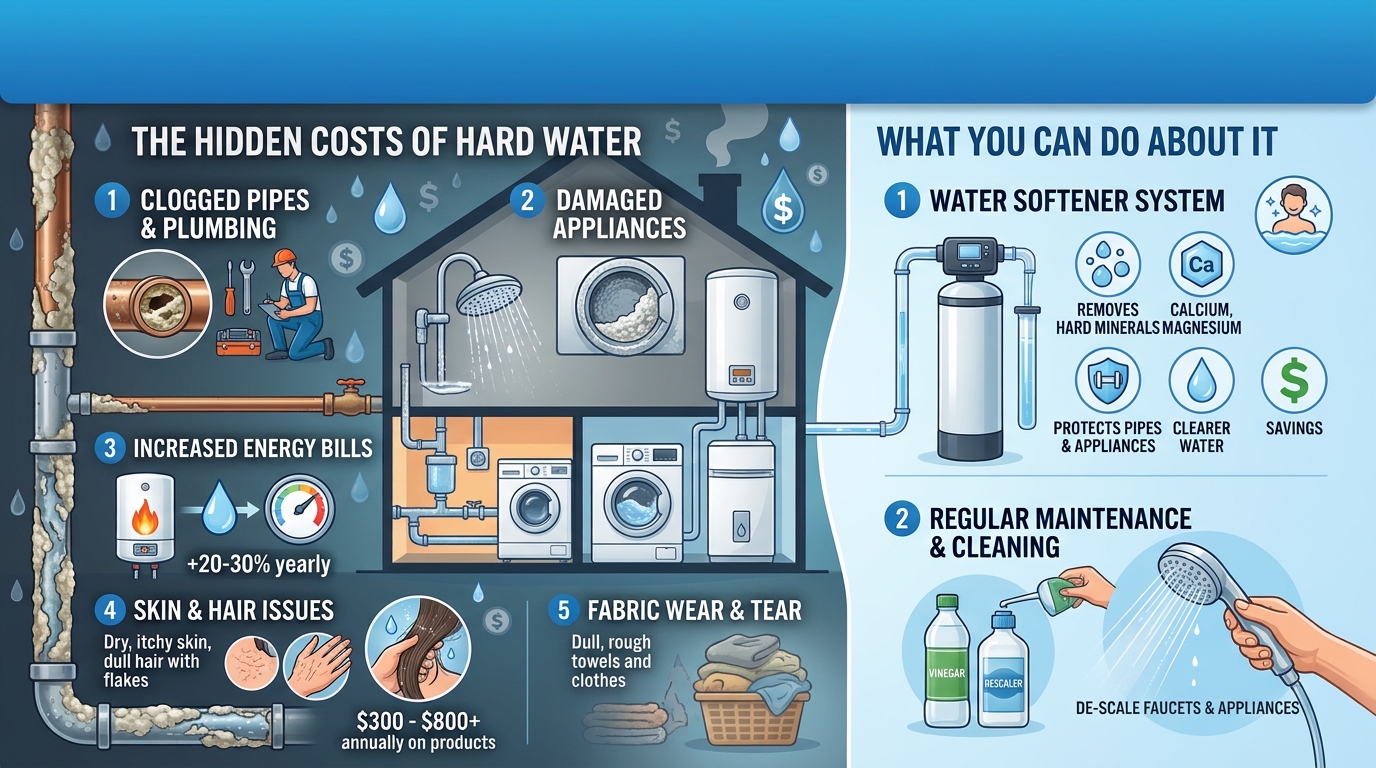
That chalky white film on your shower door isn’t just a cleaning problem. It’s a sign of what’s happening inside your pipes, your water heater and every appliance that uses water.
Hard water affects a large share of American homes, and much of the West and Midwest has some of the hardest water in the country. Most of the damage builds slowly, so homeowners often don’t connect it to the repair bills it causes until years later.
Here’s how to tell if hard water is affecting your home, where it does the most harm, and how to choose a fix that fits.
What Hard Water Is and How to Spot It
Hard water is water with high levels of dissolved minerals, mainly calcium and magnesium. It’s picked up naturally as groundwater moves through limestone and other mineral-rich rock. It’s generally safe to drink, but those minerals don’t stay in the water forever.
When hard water is heated or evaporates, the minerals come out as scale: a crusty, off-white deposit that clings to whatever it touches.
Common signs include:
- White or crusty buildup on faucets, showerheads and glass doors
- Spots on dishes and glassware straight out of the dishwasher
- Soap and shampoo that don’t lather well
- Dry skin, dull hair or stiff laundry
- Water pressure that slowly drops at certain fixtures
For a definite answer, check your local water utility’s annual quality report, or use an inexpensive home test strip. Hardness is usually listed in grains per gallon (gpg). Above about 7 gpg is considered hard, and above 10 gpg is very hard.
Where Hard Water Does the Most Damage
Water heaters. Heat drives minerals out of water faster than anything else, so scale collects at the bottom of the tank. That layer insulates the water from the burner or element, which means the heater burns more energy to do the same job. Over time, it can shorten the heater’s life and cause the popping or rumbling sounds many homeowners hear. Tankless units are affected too; scale narrows their heat exchangers and triggers error codes.
Fixtures. Showerheads, faucet aerators and toilet valves clog with deposits. Flow drops, sprays go sideways, and internal parts wear out sooner.
Appliances. Dishwashers, washing machines, ice makers and coffee makers all run water through small valves and heating elements that scale up. Many manufacturers note hard water as a leading cause of reduced performance.
Pipes. In older homes with galvanized steel pipes, mineral buildup can narrow the inside of the pipe, reducing water pressure throughout the house.
Choosing a Treatment Option
There’s no single right answer. The best fit depends on how hard your water is, what you want to protect, and how much upkeep you’re willing to do.
| Option | What it does | Best for | Keep in mind |
| Salt-based water softener | Swaps calcium and magnesium for sodium through ion exchange | Very hard water; whole-home protection | Needs salt refills; adds a small amount of sodium to water |
| Salt-free conditioner | Changes minerals so they’re less likely to stick as scale | Moderate hardness; homeowners who want low upkeep | Doesn’t remove minerals, so spotting may continue |
| Point-of-use filter | Filters water at one tap, often with reverse osmosis | Drinking and cooking water | Doesn’t protect the rest of the plumbing |
| Showerhead filter | Reduces some minerals and chlorine at the shower | Renters; skin and hair concerns | Limited effect on scale elsewhere |
Many homes combine a whole-house softener with a reverse osmosis filter at the kitchen sink. A water test before you buy tells you which system, and what size, actually makes sense.
Habits That Help in the Meantime
Even without a treatment system, a few simple habits slow the damage:
- Soak showerheads and aerators in white vinegar for an hour or two every few months to dissolve buildup.
- Flush your water heater once a year to clear sediment from the bottom of the tank. Tankless units should be descaled on the schedule in the owner’s manual.
- Run vinegar or a descaling product through the dishwasher, coffee maker and washing machine every month or two.
- Turn the water heater down to around 120°F. Hotter water drops more scale and raises scald risk.
- Wipe down glass and fixtures after use so deposits don’t harden.
When to Bring in a Plumber
Cleaning fixtures and flushing a tank are easy DIY jobs. Call a licensed plumber when:
- Water pressure has dropped throughout the house, not just at one fixture
- Your water heater is noisy, leaking or not keeping up with demand
- You’re installing a whole-house softener or conditioner, which ties into your main water line and often needs a drain and bypass valve
- You have an older home with galvanized pipes and want to know their condition
A trustworthy plumber will test your water, explain the results in plain terms, and recommend a system sized for your home, not the most expensive one on the truck.
Hard water won’t fix itself, but it doesn’t have to wear down your home either. A little knowledge and the right equipment go a long way.
About the Author
This article was written by the team at Dave Passey Plumbing, a family-owned plumbing company based in South Jordan, Utah. Serving homeowners across Salt Lake County since 1972, the company’s licensed plumbers install and service water treatment systems and water heaters in some of the hardest water in the country.
Click here for more details.